Ask every conversation the same questions.
Surveys hear from a few percent of your customers. AI Enrichments read every call, chat, email and complaint and answer the same questions each time: why they got in touch, how it felt, how hard it was, what's at risk. The result is structured data you can compare across every channel.
- Project
- Calls
- View
- Call 48213, 9 min
- SystemThis call may be recorded for quality and training purposes.
- AgentThanks for calling, you're speaking with Priya. How can I help?
- CustomerMy bill has two different amounts on it and I can't tell which one I owe. This is the second time I've rung about it.
- SystemHold music, 2 min 14 s
- AgentThe credit from last month comes off the next bill, so this one's higher.
- CustomerNobody explained that. If it happens again I'll look at other providers.
- SystemEmail signature and privacy notice, 6 lines
Why it matters
- Survey response rates sit at around 3–5%, so most decisions rest on the loudest few.
- QA teams review a tiny share of calls by hand, so most coaching moments and compliance issues are missed.
- Agents categorise cases differently, so trends shift whenever the team changes.
- Each channel uses its own categories, so calls, chats and surveys can't be compared.
How it works
- 01ConnectCalls, chats, emails, complaints, reviews and surveys flow into Kapiche.
- 02EnrichEach enrichment answers one question, the same way, on every conversation in every channel.
- 03AnalyseTheme Builder and driver analysis work on the new fields, so you see what's behind every number.
- 04ActResults flow into Smart Reports, alerts, your AI tools and your own systems.
The enrichments
Reason for contact
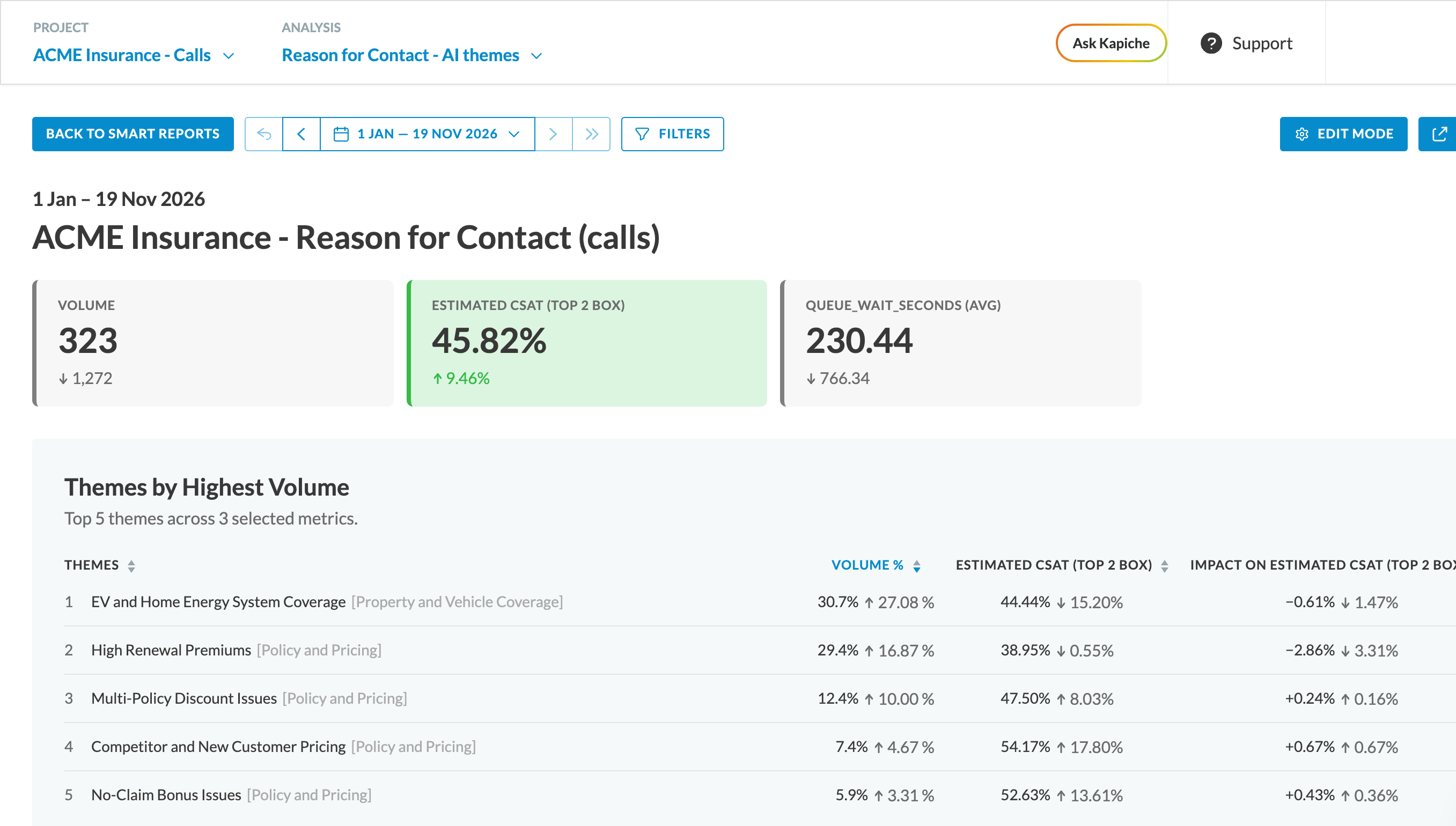
Why the customer got in touch, without relying on agent categories. Shows what drives volume and which contact was avoidable.
Estimated metrics
Estimated CSAT, effort (CES), NPS and resolution for every interaction, with the reason behind each score. A survey-like measure for 100% of conversations.
Demand management
Sorts contact into failure demand, avoidable demand and value demand, so you know what to fix, what to move to self-service and what to protect.
Emotion
How the customer felt from start to finish, and where conversations escalate or recover.
Journey moments
Where in the journey each conversation sits, from joining to claiming to leaving, so issues land with the right owner.
Risk signals
Churn, compliance and reputational risk, each switched on separately, with the evidence behind every flag.
Product pain points and feature requests
Bugs, frustrations and requests from every channel, counted and ready for the product team.
Custom enrichments
Bring us the question. If you can describe what you need from a conversation, we can build an enrichment to answer it on every one.
Related
Agent QA scores every agent interaction against your scorecard.
Agent QA
Failure demand38%
Contact caused by something going wrong (924)
“I was told my refund would be in my account last week. It still isn't.”
Action: Fix the process
Avoidable demand27%
Contact self-service could have handled (656)
“Just checking my payment went through.”
Action: Move to self-service
Value demand35%
Contact customers want to make (851)
“I'd like to add my daughter to my policy.”
Action: Protect it and make it easy
2,431 conversations across calls, chat, email, complaints and AI agent chats
A measure you can trend and compare.
Every enrichment uses the same method on every conversation, whichever channel it came from. So you can compare satisfaction on calls and chat with confidence, and trust that a trend reflects customers, not a change in who did the tagging.
Example: satisfaction slipping in one journey
In one provider's billing journey, the second largest source of contact, estimated CSAT fell from about 3.5 to 3.0 over a month. Enrichments and themes showed why: self-service friction with payment plans, unclear bills, and customers in financial stress blocked by digital systems.
Billing journey3.5 → 3.0 in 4 weeks
1Payment plan self-service friction41%
“I tried three times to set up a payment plan online and gave up.”
2Bills that are hard to understand33%
“I can't work out why this bill is higher than the last one.”
3Customers in financial stress blocked by digital systems26%
“The app won't let me ask for more time, and I can't afford to pay it all now.”
Estimated CSAT on every billing conversation, out of 5. Illustrative example
Pricing
Each enrichment is priced on its own. You only pay for what you switch on.
PricingResults
- 23,000 calls analysed in a proof of concept, finding pain points surveys missed
Kapiche streamlined our insights reports from 20 pages to 5, focusing on key drivers of satisfaction and their impact on CSAT. These insights became crucial for building business cases and for forecasting benefits.
 Emma WuHead of Customer Experience, PEXA

Questions
- How accurate are estimated scores?
- We validate each enrichment against human ratings with your team before you rely on it. Because estimated scores use the same method on every conversation, trends are reliable even where a single score differs from a human view.
- Do we still need surveys?
- Yes, for the questions only surveys can answer. Many customers use Kapiche alongside a CX platform such as Qualtrics, Medallia or InMoment, and enrichments fill the gap between surveys.
- What data can be enriched?
- Any text or audio: calls, chats, emails, tickets, complaints, reviews and survey comments.
- Can we start with one enrichment?
- Yes. Most teams start with one or two, such as reason for contact or estimated CSAT, and add more as they go.